Fermentation Safety
Fizz Business: Why Bottled Kombucha Needs a Pressure Plan
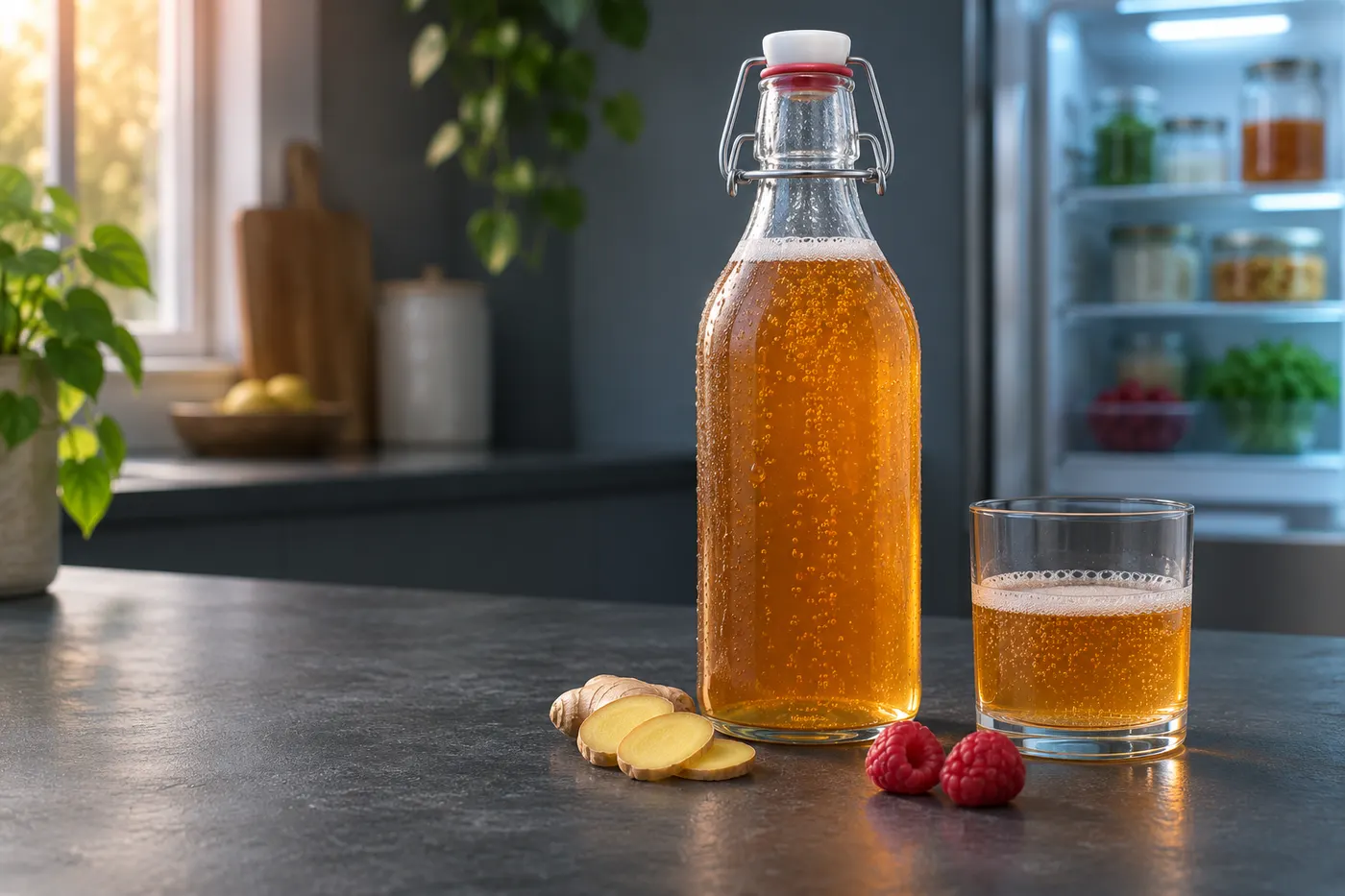
A tight cap turns a living ferment into a tiny pressure chamber. Here’s how time, sugar and temperature build bubbles—and why the refrigerator matters.
A bottle of homemade kombucha can look serenely still while its microscopic crew works the night shift. Once the cap is tight, the carbon dioxide that used to drift away has nowhere easy to go. The result may be a pleasant sparkle, an enthusiastic fountain or, if pressure outruns the container, broken glass.
The first ferment and the bottled stage are different environments. During the usual first stage, sweet tea and a culture of yeasts and bacteria sit in a vessel covered with breathable cloth. Bottling closes the system. If live yeast and fermentable sugar remain—and they usually do—the chemistry does not stop simply because the drink has moved into a nicer container.
Yeast converts sugar into ethanol and carbon dioxide. In a sealed bottle, some carbon dioxide dissolves into the drink and makes fizz; the rest raises pressure in the headspace. Pennsylvania’s food-safety guidance treats active fermentation in a closed kombucha bottle as a physical hazard because enough pressure can cause leaks, cap failure or glass breakage. The same continuing fermentation can also raise alcohol content.
Fruit, juice or extra sugar added for flavour can give yeast more fuel. Time and storage temperature also influence how fermentation proceeds. That makes a recipe’s timetable a starting point, not a pressure gauge: two bottles prepared alike can behave differently when the culture, sugar level or room temperature changes. That last point is a practical inference from the variables identified by food-safety authorities, not a promise that every bottle will carbonate at the same rate.
Colorado State University Extension, in guidance reviewed in October 2025, says tightly capped kombucha may be left at room temperature for one to three days for potential carbonation—or refrigerated immediately—and warns that longer capped storage at room temperature can allow carbon dioxide to accumulate enough to cause an explosion. Utah State University’s tested home instructions likewise use a one-to-three-day bottled stage, direct brewers to release pressure daily, and refrigerate once the desired fizz is reached.
The refrigerator is a brake, not a time machine. Health Canada advises refrigerating fermented drinks such as kombucha to limit fermentation, and notes that their ethanol level can vary with both production and storage. For someone who must avoid alcohol completely, a homemade fermented drink should not be assumed alcohol-free without reliable measurement.
A sensible home plan is wonderfully unglamorous: follow a tested university-extension recipe, keep equipment clean, leave the specified headspace, mark the bottling date and keep the room-temperature stage short. Follow that recipe’s pressure-release directions, refrigerate promptly when the fizz is ready, and open the bottle thoroughly chilled, upright and pointed away from faces. The final opening advice is a cautious handling step, not a substitute for controlling fermentation.
Acidity and pressure answer different questions. Reaching an appropriately acidic pH helps control certain unwanted microbes, but it does not prove that yeast has stopped making gas. A tart bottle can still be an active bottle. If there is mould, a damaged container, leakage or any sign that the batch is not behaving as expected, do not taste-test your way through the doubt; discard it safely and start again with validated instructions.
The fun of bottle conditioning is that living microbes make the bubbles. The responsibility is remembering that they do not read the clock. Give a ferment a clean process, a short and monitored bottled stage, and a prompt trip to the fridge—then let the fizz stay in the glass instead of redecorating the ceiling.
Sources
- https://extension.colostate.edu/resource/understanding-and-making-kombucha/
- https://extension.usu.edu/preserve-the-harvest/kombucha
- https://www.canada.ca/en/health-canada/services/publications/food-nutrition/ethanol-non-alcoholic-fermented-beverages.html
- https://www.pa.gov/content/dam/copapwp-pagov/en/pda/documents/consumer_protection/foodsafety/manufacturing-packing-holding-distribution/documents/Guidelines%20for%20brewing-bottling%20Kombucha.pdf
You may also like these